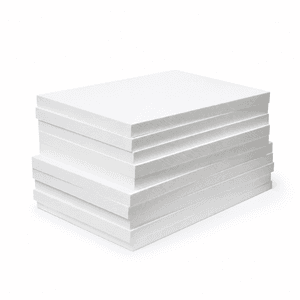
Ceramic Fiber Board

Ceramic Fiber Board

Ceramic Fiber Insulation Board, Ceramic Fire Board
Ceramic Fiber Board1050–1800°C300–700 kg/m³Custom Size

CVSIC Ceramic Fiber Board offers exceptional insulation performance, with temperature grades from 1050°C to 1800°C for ceramics, glass, metallurgy, chemical, mechanical, optoelectronics, environmental protection, laboratory, and R&D applications. Custom sizes, density, composition, and packaging are available with global wholesale supply. Name: CVSIC ceramic fiber board Temperature: 1050-1800°C Density: 300-700 kg/m³ Size: Customized according to customer requirements Chemical composition: Adjustable AL₂O₃, SiO₂, ZrO₂, and other composition ratios Packaging: Carton, wooden crate, or pallet packaging Technical support: Selection advice, design, and installation guidance Brand: CVSIC

Description

CVSIC Ceramic Fiber Insulation Board Description

CVSIC Ceramic Fiber Board is manufactured using high-purity ceramic fiber cotton and a small amount of binder through a vacuum forming process, offering superior thermal insulation performance, high mechanical strength, and low thermal shrinkage.

The product series covers eight temperature grades: 1050°C, 1260°C, 1350°C, 1400°C, 1430°C, 1600°C, 1700°C, and 1800°C, meeting high-temperature industrial insulation needs in ceramics, glass, metallurgy, chemicals, laboratories, and R&D. Hydrophobic and inorganic ceramic fiber boards are also available for high-humidity and low-emission applications.

Ordering Information

Temperature Grade:
1050°C, 1260°C, 1350°C, 1400°C, 1430°C, 1600°C, 1700°C, 1800°C
Density:
300-600 kg/m³ for CV1050-CV1600 and 450-700 kg/m³ for CV1700-CV1800
Standard Size:
1200/600×1000×6-105 mm, 1200×500×6-105 mm; CV1600 and above also support 1000/900×600×20-150 mm
Main Composition:
AL₂O₃, SiO₂, ZrO₂, and other compositions depending on grade
Packaging:
Carton, wooden box, or pallet; customizable according to requirements
Note:
Dimensions and packaging can be customized according to customer requirements.

Application Fields

Ceramic Industry:
Backing and hot-face lining for high-temperature sintering furnaces and ceramic kilns.
Glass Industry:
Insulation materials for glass melting furnaces and annealing furnaces.
Metallurgy Industry:
Backing and thermal insulation for heat treatment and aluminum industry furnaces.
Chemical and Mechanical Industries:
Thermal insulation protection for high-temperature reactors and equipment.
Optoelectronics and Environmental Protection:
Thermal barriers for semiconductor manufacturing furnaces and environmental protection equipment.
Laboratories and R&D:
Thermal insulation and structural materials for high-temperature experimental furnaces.

Advantages

Chemical Stability:
High AL₂O₃+SiO₂ content up to ≥99% with low impurities for reliable performance.
Excellent Thermal Insulation:
Low thermal conductivity of 0.084 W/m·K at 400°C significantly reduces energy consumption.
High-Temperature Stability:
Withstands temperatures up to 1800°C with low linear shrinkage down to ≤1.0% at 1650°C.
High Mechanical Strength:
Resistant to airflow erosion, with bending strength ≥0.7 MPa for CV1600 and above.
Hydrophobic Performance:
Hydrophobic boards perform well in high-humidity environments.
Environmentally Friendly:
Inorganic boards do not emit pollutants at high temperatures and meet clean-process requirements.
Easy Processing and Installation:
Precise dimensions and smooth surface make the board easy to cut and install.

Installation Method

1. Select Temperature Grade:
Choose the grade based on actual service temperature and furnace atmosphere.
2. Keep Operating Margin:
In oxidizing or neutral atmospheres, use 100-250°C below the maximum grade temperature; in reducing atmospheres, use 200-350°C below the maximum operating temperature.
3. Cutting and Processing:
Cut to fit the furnace chamber or component size with suitable tools and dust control.
4. Installation:
Fix boards with suitable anchoring and avoid point loads that may crack the board.
5. Inspection:
Regularly inspect cracks, erosion, and shrinkage, especially on the hot face.

Design Recommendations

Match Grade to Atmosphere:
Select the CV grade based on actual temperature and atmosphere type, such as oxidizing, neutral, or reducing.
Density Selection:
Use 300-600 kg/m³ for general applications and 450-700 kg/m³ for higher-temperature or harsher conditions.
Reduce Thermal Bridges:
Design joints and anchors to minimize heat loss through fixation points.
Choose Hydrophobic or Inorganic Options:
Choose hydrophobic boards for humid environments or inorganic boards for low-emission applications.
Packaging and Transport:
Select cartons, wooden boxes, or pallets according to quantity and logistics needs to prevent damage.

Customization Services

Size and Specification Customization:
Available in multiple sizes such as 1200/600×1000×6-105 mm and 1000/900×600×20-150 mm, customizable by furnace type.
Hydrophobic and Inorganic Options:
Hydrophobic or inorganic ceramic fiber boards are available for high humidity or environmental requirements.
Reinforcement Material Selection:
Glass fiber or steel wire reinforcement is available to enhance strength and temperature resistance.
Packaging Customization:
Packaging options include cardboard boxes, wooden boxes, or pallets for bulk transportation and storage.
Technical Support:
A professional team provides selection recommendations, installation guidance, and maintenance support.

Ready to order or need a custom spec?

Open LINE chat