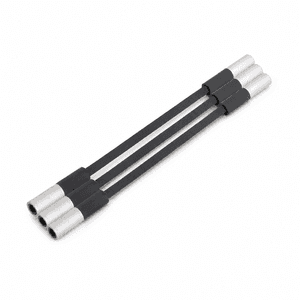
DB Type SiC Heater Rods

DB Type SiC Heater Rods

DB Type SiC Heating ElementsRodsHeater

CVSIC DB Type (Dumbbell) Silicon Carbide Heating Element, up to 1625°C (2957°F), high-temperature and corrosion-resistant, great for ceramics, electronics, lithium batteries, and high-temperature kilns. Offering global wholesale, customization, and OEM/ODM services. Contact us for free samples! Material: High-purity Silicon Carbide (SiC), ≥99% content Type: DB Type Power Supply: 110-480V Production Process: High-quality SiC blank, high-temperature silicon recrystallization Diameter: 8-65mm Operating Temperature: Up to 1625°C (2957°F) Packaging: Inner carton with foam padding, outer export wooden crate Applications: Industrial heaters, furnace heaters After-Sales Service: Global service center support

Ordering Information

OD:
Outer Diameter (mm)
HZ:
Hot Zone Length (mm)
CZ:
Cold Zone Length (mm)
OL:
Overall Length (mm)
d:
Hot Zone Diameter (mm)
Resistance:
Ω
Example:
DB Type, d=8mm, D=14mm, HZ=150mm, CZ=100mm, OL=350mm, Resistance=1.5Ω, denoted as: dia8/14x150x350mmx1.5Ω

Connection Method

Contact Surface Design:
The cold end is coated with an aluminum strip for low-resistance contact, ensuring efficient conductivity.
Electrical Connection:
Secured with a flat aluminum braid and spring clips, suitable for single- or double-end connections, ensuring a stable installation.
Note:
Select the appropriate voltage (110-480V) and connection method based on furnace power and temperature requirements. Use an SCR voltage regulator (a device for precise temperature control) to extend lifespan.

Application Fields

Small Box Furnaces:
Supports laboratory and small-scale industrial heating needs.
Laboratory Furnaces:
For material testing and high-temperature experiments.
Tunnel/Muffle Furnaces:
Meets ceramic sintering and powder metallurgy process requirements.
Electronics Industry:
Used in semiconductor manufacturing and electronic component encapsulation.
Lithium Battery Materials:
Supports high-temperature processing of battery anode and cathode materials.
Rare Earth Phosphors and Precision Casting:
Provides high-temperature stability and uniform heating.

Advantages

High-Temperature Resistance:
Operates up to 1625°C (2957°F), ideal for demanding high-temperature environments.
Low Aging:
High-density silicon carbide (2.8 g/cm³) is oxidation-resistant, slows down aging, and ensures a long lifespan.
Quick and Uniform Heating:
Thickened cold zones and high-resistance hot zone design enable rapid and uniform heating.
Corrosion Resistance:
Self-bonded silicon carbide material resists acids and alkalis, suitable for harsh conditions.
Flexible Installation:
Self-supporting design for easy setup in vertical or horizontal installation, allows replacement at operating temperatures.
Global Service:
ISO-certified factory, 360-ton annual capacity, offers free samples, and 7-30 day delivery.

Installation Method

1.Inspect Element:
Before installation, ensure the element is free of cracks or damage.
2. Installation Type:
Supports both vertical and horizontal installation; the self-supporting design requires no additional support.
3. Fixing Device:
Use ceramic chucks or dedicated clamping devices to avoid direct metal contact.
4. Power Connection:
Connect to a 110-480V power supply with flat aluminum braid and spring clips for proper resistance matching.
5. Hot Furnace Replacement:
Replace at operating temperatures by turning off the power, loosening the spring clips and aluminum braid, and smoothly inserting the new element to avoid thermal shock or melting of the aluminum coating.
6. Ventilation:
Maintain good ventilation in the installation area to prevent localized overheating.
7. Preheating:
Gradually increase power during first use to avoid thermal shock.
8. Regular Maintenance:
Check aluminum coating connections and clamps for looseness or corrosion.

Design Recommendations

Hot Zone Length:
Match the hot zone length to the furnace width to avoid insertion into the furnace wall, preventing ablation.
Cold Zone Length:
Cold zone length should equal furnace wall thickness plus 50-150mm extension for accessory connection.
Furnace Aperture:
The furnace aperture should be 1.4-1.6 times the cold zone diameter to allow free expansion and prevent cracking.
Spacing Design:
Maintain ≥3 times the outer diameter between the element and material/furnace wall and ≥4 times the outer diameter for center-to-center spacing to optimize heat distribution.
Temperature Control System:
Use a PID controller for precise temperature control to extend the element’s lifespan.
Hot Furnace Replacement:
Control insertion speed during replacement to avoid aluminum coating melting or thermal shock.

Ready to order or need a custom spec?

Open LINE chat